
Apollo vs ZoomInfo: Which B2B Data Provider Platform Wins in 2026?
Choosing a B2B data provider shapes how your entire go-to-market motion runs, from how reps find prospects to how marketing builds target account lists. Apollo and ZoomInfo are two of the most searched-for names in sales intelligence, but they take different approaches to combining data with execution.
This comparison breaks down features, pricing, and use cases so RevOps leaders, sales professionals, and GTM teams can make an informed decision in 2026.
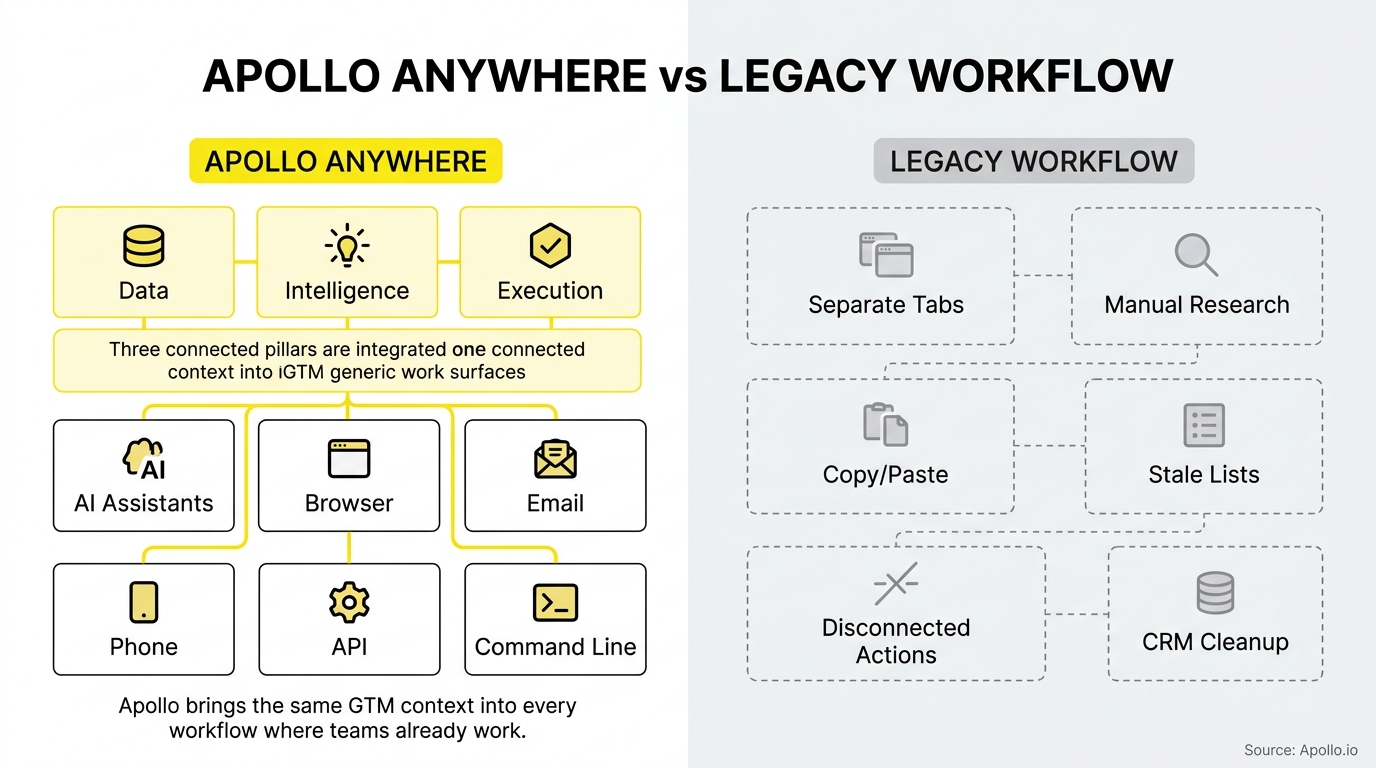

Let Apollo Do the Research for You
Tired of reps burning hours on manual lead research instead of selling? Apollo surfaces verified contacts instantly so your team spends time closing, not digging. Join 600K+ companies building pipeline faster.
Start Free with Apollo →Key Takeaways
- Sales intelligence with built-in execution: Apollo pairs its contact and company database with sequencing, dialer, and workflow automation in one workspace, while ZoomInfo delivers data and intelligence alongside engagement tools through separate product modules like Engage and Copilot.
- AI-native access: Apollo is accessible directly inside AI assistants via Apollo MCP, giving GTM Engineers and AI Builders headless, API-driven ways to work with sales data, in addition to its web app and Chrome extension.
- Transparent pricing model: Apollo publishes its per-seat pricing publicly, while ZoomInfo pricing is quote-based and varies by license count, data credits, and feature tier.
- Platform scope for every team size: Apollo serves B2B GTM teams, GTM Engineers, and AI Builders building headless GTM workflows with the Apollo API, CLI, and MCP, alongside Sales Professionals, SDRs/BDRs, AEs, RevOps, Marketing, and Revenue Leaders, from startups through companies at enterprise scale.
- AI feature velocity: Apollo has reported rapid adoption of its AI Assistant and AI credit usage in 2026, signaling fast-moving investment in AI-driven prospecting and research capabilities.
What is Apollo?

Apollo is an AI GTM system that unifies data, intelligence, and execution. It gives sales professionals, SDRs/BDRs, AEs, RevOps, marketing, and revenue leaders a single place to find prospects, run outbound and inbound motions, enrich records, and analyze pipeline performance.
The platform's database includes 240M+ people and 30M+ companies, with contact records validated through Apollo's Living Data Network and a reported 98% email accuracy rate.
Apollo is built open by design: it meets sellers inside the tools they already use rather than asking them to switch contexts. That includes Apollo MCP, Apollo's Model Context Protocol, which connects Apollo's data and workflows to AI assistants like ChatGPT, Codex, Claude, and Perplexity. Sellers can also prospect across the web using Apollo's Chrome extension, and technical teams building headless GTM workflows can use Apollo CLI for terminal-native access.
According to Ramp's vendor data, drawn from real spend across American businesses, Apollo held a 39% adoption rate among Sales Data Providers buyers as of August 2026, ranking #2 in the category and capturing the highest share of first-time category buyers among tracked vendors. Mid-market companies represent Apollo's largest customer segment by company size, and enterprise adoption has climbed in recent months, pointing to expanding use beyond its early SMB base.

Core capabilities span prospecting and search, multi-channel sequencing across email, phone, and social, an integrated Power and Parallel Dialer, AI-assisted research and lead scoring, and data enrichment through waterfall, CRM, CSV, and API methods. Apollo offers transparent pricing starting at $49/user/month (annual billing), with a free tier available for teams that want to test data quality before committing.
What is ZoomInfo?

ZoomInfo describes itself as an AI-assisted go-to-market intelligence platform built on B2B data. It combines contact and company data, buyer intent signals, AI prioritization, CRM enrichment, workflow automation, and sales engagement tools to help teams identify prospects and act on buying signals.
ZoomInfo's core database includes verified contact and company profiles with mobile numbers and business email addresses, searchable through quick and advanced filters. Beyond the core database, ZoomInfo offers Copilot for AI-assisted account prioritization and buyer intent, ZoomInfo Engage for sales engagement automation and dialer functionality, Chorus for conversation intelligence, and Marketing Demand and ABM products for audience creation and campaign orchestration.
Firmographic, technographic, and funding data are also included as part of company intelligence.
ZoomInfo's product suite is organized into named tiers, including ZoomInfo Professional, Copilot Advanced, Copilot Enterprise, Marketing Demand, ABM Lite, and ABM Enterprise. The official ZoomInfo pricing page lists feature sets and credit allotments, such as 75K included credits for Marketing Demand and 150K included credits for ABM Enterprise, but does not display dollar figures. ZoomInfo's pricing is not publicly displayed; prospective buyers submit contact information to receive a quote.
ZoomInfo primarily serves sales teams, marketing and ABM teams, and recruiting teams across company sizes, including companies with more complex data and intent-signal needs.

Feature Comparison
| Feature | Apollo | ZoomInfo |
|---|---|---|
| Starting Price | $49/user/month (annual billing) | Not publicly displayed (Vendr) |
| B2B Database | 240M+ people, 30M+ companies | ZoomInfo claims a large contact and company database (exact figures not publicly listed) |
| Email Accuracy | 98% reported accuracy | not publicly displayed |
| Sequences | Included on paid plans, multi-channel (email, phone, social) | Included via ZoomInfo Engage module |
| Dialer | Power Dialer and Parallel Dialer included on Professional and Organization plans | Included via ZoomInfo Engage module |
| AI Capabilities | AI Assistant, AI Sequence Builder, AI research and lead scoring, accessible via Apollo MCP | Copilot AI prioritization, AI-generated account summaries, and AI email generation |
| Data Enrichment | Waterfall, CRM, CSV, and API enrichment | CRM enrichment and automatic data updates |
| Free Trial | Free tier with 900 credits/year | Free trial available (details via sales contact) |
Fill Your Funnel With Buyers, Not Noise
Running out of qualified leads before the quarter ends? Apollo surfaces in-market prospects that match your ICP so your outreach lands — not bounces. 600K+ companies stopped guessing and started closing.
Start Prospecting →Both platforms cover the fundamentals of B2B sales intelligence: verified contact data, firmographic detail, and AI-assisted prospecting. The clearest structural difference is packaging.
Apollo bundles data, engagement, and analytics into a single per-seat subscription, while ZoomInfo organizes its capabilities into distinct product modules (Professional, Copilot, Engage, Marketing Demand, ABM) that are typically priced and licensed separately.
Pricing Comparison
Apollo publishes its pricing directly on its pricing page. Plans are billed annually and include:Free ($0, 900 credits/year, 2 sequences, basic filters), Basic ($49/user/month, 30,000 credits/year, unlimited sequences, CRM integrations, 6 intent topics), Professional ($79/user/month, 48,000 credits/year, US dialer, 5 mailboxes, automated workflows, AI research), and Organization ($119/user/month, minimum 3 users, 72,000 credits/year, international dialer, 15 mailboxes, SSO, advanced security). Monthly billing is also available on Basic and Professional plans; visit the pricing page for current options.
ZoomInfo's pricing is not publicly displayed on its official website. Instead, prospective customers submit contact details through a "Get Pricing" form or request a demo for tiers like ZoomInfo Professional, Copilot Advanced, Copilot Enterprise, Marketing Demand, ABM Lite, and ABM Enterprise.
According to Vendr, ZoomInfo's Median Avg Contract Value is $33,500 per year, based on data from 1,570 purchases, with Vendr having handled 1,012 deals. Vendr notes that ZoomInfo pricing combines license count, feature tier, data credit allocations, and contract length, with intent data, conversation intelligence, and advanced integrations often carrying additional cost.
For teams comparing total cost of ownership, Apollo's published per-seat pricing allows direct budgeting, while ZoomInfo buyers typically need a sales conversation to scope licenses and credit needs against Vendr's benchmark contract data.
How Apollo Differs from ZoomInfo
Apollo's contact and company records are continuously validated and refreshed through its Living Data Network, rather than relying on a static, periodically updated database. This is paired with engagement execution, sequencing, dialer, and workflows, built into the same subscription rather than layered on as an add-on module.
According to Ramp's Sales Data Providers category data, Apollo was the fastest-growing vendor in the category as of August 2026, averaging roughly 0.6 percentage points of adoption growth per month, ahead of every other tracked sales data provider. That growth trend, combined with a rising share of buyers switching in from other category vendors, suggests teams are actively consolidating research, outreach, and enrichment workflows onto a single platform rather than maintaining several point tools.

Apollo's free tier also lets teams test data quality and workflow fit before committing to a paid plan, a lower-friction entry point than a quote-based sales process. And with 50+ integrations including Salesforce, HubSpot, and Zoho CRM, Apollo fits into existing tech stacks without requiring a full rebuild.
Customers describe the effect of this consolidation directly. Sylvain Giuliani, Head of Growth & Operations at Census, said: "We paid less for one tool than for two tools together...we cut our costs in half." And Kevin Warner, CEO at Leadium, noted: "Apollo became the single source of truth for us, where everything originates from and where all the data returns to."
Apollo has also been recognized externally, including the 2025 MarTech Breakthrough Award for "Best AI-Powered Sales Solution" and 624 badges in G2's Winter 2026 Report.
Frequently Asked Questions
Is Apollo cheaper than ZoomInfo?
Apollo publishes its pricing directly, as detailed in the pricing section above. ZoomInfo's pricing is quote-based, though Vendr's benchmark data offers a general sense of typical contract values.
Because the two platforms package features differently, a direct dollar-for-dollar comparison depends on which modules and credit volumes a team needs.
Does Apollo include engagement tools like ZoomInfo Engage?
Yes. Apollo includes sequencing, dialer functionality, and workflow automation as part of its core subscription rather than as a separately licensed module, as covered in the Feature Comparison table above.
Which platform has better AI capabilities?
Both platforms have invested in AI features. Apollo offers an AI Assistant, AI Sequence Builder, and AI-based research, and is accessible directly inside AI assistants via Apollo MCP.
ZoomInfo offers Copilot for AI-assisted prioritization and account summaries. Teams evaluating AI capabilities should test each platform's AI tools against their own workflows.
Is Apollo suitable for small teams?
Apollo offers a Free plan at $0/month for teams that want to test the platform, and a Basic plan starting at $49/user/month (annual billing) for teams ready to scale outreach with unlimited sequences and CRM integrations.
Who is Apollo built for?
Apollo serves B2B GTM teams, GTM Engineers, and AI Builders building headless GTM workflows with the Apollo API, CLI, and MCP, alongside Sales Professionals, SDRs/BDRs, AEs, RevOps, Marketing, and Revenue Leaders, spanning startups through companies at enterprise scale.
Prove Pipeline ROI With Apollo
ROI pressure killing your next tool approval? Apollo delivers measurable pipeline outcomes your exec team can actually see. Leadium 3x'd annual revenue — your CFO will notice that.
Start Free with Apollo →Conclusion
Apollo and ZoomInfo both provide B2B contact data, AI-assisted prospecting, and sales engagement capabilities, but they differ in how those capabilities are packaged and priced. Apollo brings data, engagement, and AI-powered execution together as a connected go-to-market system with transparent, published pricing, while ZoomInfo organizes its offering into modules with quote-based pricing scoped to each customer's needs.
For teams that want to test data quality, run outbound, and manage enrichment inside one workspace before committing to a contract, try Apollo free today.
Don't miss these
Sales
Inbound vs Outbound Marketing: Which Strategy Wins?
Sales
What Is a Sales Funnel? The Non-Linear Revenue Framework for 2026
Sales
What Is a Go-to-Market Strategy? The 2026 GTM Playbook
See Apollo in action
We'd love to show how Apollo can help you sell better.
By submitting this form, you will receive information, tips, and promotions from Apollo. To learn more, see our Privacy Statement.
4.7/5 based on 9,690 reviews
