
Cold Email Reply Rates: What to Expect From a Well-Run Campaign
If your outbound cold email campaign is generating a 1% reply rate, that's a problem. If it's hitting 3–5%, you're in the normal range for a well-run campaign in 2026.
If you're clearing 8%+, you're doing something right. Knowing where you stand matters before you can improve — and the benchmarks have shifted enough in the past two years that many teams are operating with outdated expectations.
This guide breaks down what reply rates to expect, what drives variance, and how SDRs and sales leaders can set realistic targets backed by current data. For context on the full outreach process, see the outbound prospecting guide.

Research Less, Close More With Apollo
Tired of burning hours hunting down emails that bounce and numbers that go nowhere? Apollo delivers verified contact data so your team spends time selling, not searching. Join 600K+ companies building pipeline faster.
Start Free with Apollo →Key Takeaways
- A well-run outbound cold email campaign in 2026 should target a 3–5% reply rate as a realistic baseline, not a ceiling.
- Top-quartile performers achieve materially higher rates — but usually through precise ICP targeting and signal-triggered timing, not copy tricks.
- Deliverability is now a first-order constraint: if your email infrastructure isn't solid, reply rates suffer regardless of message quality.
- List size matters: smaller, tightly targeted lists consistently outperform large-volume blasts.
- SDRs and BDRs who track positive reply rate (not just any reply) get a more accurate read on campaign health.
What Is the Expected Reply Rate for a Well-Run Outbound Cold Email Campaign?
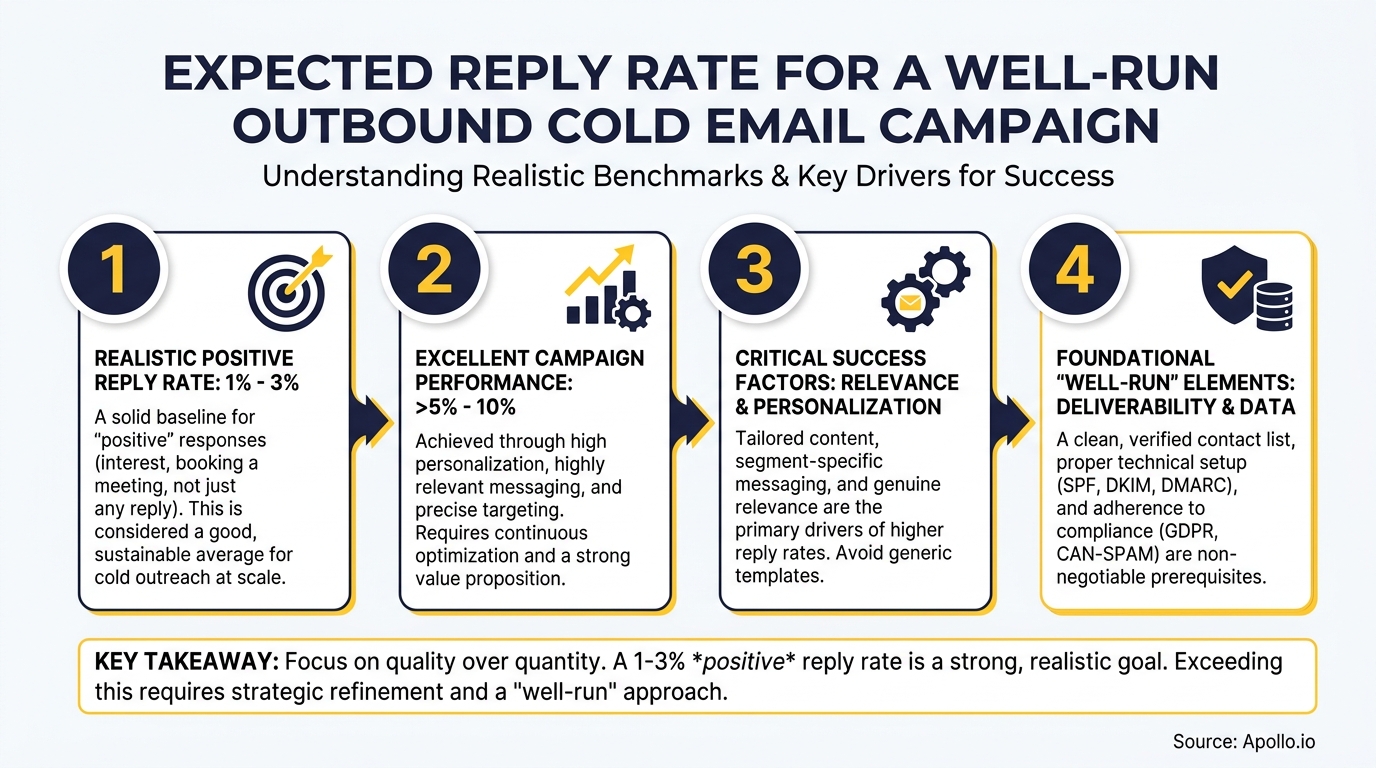
A well-run outbound cold email campaign in 2026 should expect a reply rate between 3% and 5% as a realistic average, with top performers reaching 8–12%. According to Cleanlist, the average cold email reply rate in 2026 sits at around 3.1%, with top performers reaching 8–12%. Research from The Digital Bloom found that average B2B cold email reply rates ranged from 3% to 5.1%, with top-quartile performers achieving 15% to 25% — though those outliers typically involve narrow niches, intent signals, and pristine sender reputation.
| Performance Tier | Reply Rate Range | What It Signals |
|---|---|---|
| Below average | <2% | Deliverability issues, poor targeting, or generic messaging |
| Average (well-run) | 3–5% | Solid ICP targeting, reasonable personalization |
| Strong | 5–8% | Precise targeting, relevant messaging, good follow-up cadence |
| Excellent | 10%+ | Signal-triggered outreach, tight niche, high-relevance offers |
According to Martal, hitting 10%+ is considered excellent in most industries. And Oppora notes that a B2B cold email response rate between 5% and 8% is considered strong performance in 2026, indicating precise ICP targeting, relevant messaging, and correctly structured follow-ups.
Turn Weak Leads Into Pipeline With Apollo
Quota pressure mounting while marketing leads stall before they ever become opportunities? Apollo surfaces in-market buyers with verified contact data so your team reaches the right prospect at right moment. Join 600K+ companies building predictable pipeline.
Start Free with Apollo →Why Do Reply Rates Vary So Much Across Campaigns?
Reply rate variance comes from four primary variables: list quality, message relevance, deliverability, and list size. Each one compounds the others.
- List size: Smaller lists outperform larger ones. Campaigns sent to 50 or fewer recipients consistently see higher reply rates than campaigns sent to 1,000+. Volume and precision trade off against each other.
- Message relevance: Generic outreach is increasingly punished by buyers. Personalization tied to a specific trigger (job change, funding, tech adoption) earns more replies than persona-based templates.
- Deliverability: If your emails land in spam, your reply rate is zero regardless of copy quality. Authentication (SPF, DKIM, DMARC) and spam complaint rates directly gate your ability to reach inboxes.
- Timing and cadence: Sending at the wrong time or without follow-up touches significantly reduces total replies. Learn more about the best time to email and call prospects for higher engagement.
Struggling to reach the right contacts in the first place? Search Apollo's 230M+ contacts with 65+ filters to build tighter, higher-converting prospect lists.

How Does Deliverability Affect Cold Email Reply Rates?
Deliverability is now the primary constraint on cold email performance — not copy, not subject lines. If your emails don't reach the inbox, reply rate optimization is irrelevant.
Google's bulk sender guidelines require spam complaint rates to stay below 0.3%, with a target under 0.1% for sustained inbox placement. Violations at scale result in throttling or blocking.
A well-run campaign in 2026 requires:
- SPF, DKIM, and DMARC authentication on all sending domains
- One-click unsubscribe links for bulk sends
- Spam complaint monitoring (ideally via Google Postmaster Tools)
- Warmed-up sending domains before high-volume campaigns
- Verified contact emails to minimize hard bounces
Teams that skip infrastructure setup and then optimize subject lines are solving the wrong problem. Check out the guide on how to improve email deliverability in 5 easy steps before scaling any campaign.
How Do SDRs and BDRs Set Accurate Reply Rate Benchmarks?
SDRs and BDRs often track total reply rate, but positive reply rate is a more useful signal. A total reply rate includes out-of-office messages, unsubscribe requests, and negative responses — none of which advance pipeline.
Tracking positive replies separately gives a cleaner read on campaign effectiveness.
For SDRs running outbound sequences, a practical benchmarking framework looks like this:
- Minimum viable: 2–3% positive reply rate (investigate if below this)
- Target: 4–6% positive reply rate (signals solid targeting and messaging)
- Stretch: 8%+ positive reply rate (typically requires signal-triggered or hyper-niche outreach)
For help crafting emails that earn genuine responses, see how to write cold email introductions that get replies and the best cold email subject lines to boost open rates.
Spending hours writing and sending sequences manually? Automate your multi-channel sequences with Apollo's sales engagement platform and focus on replies, not logistics.
What Messaging Strategies Actually Improve Reply Rates?
The most effective messaging strategies in 2026 move away from persona-based templates toward signal-triggered, relevance-first outreach.
Here's what works:
- Lead with a trigger: Reference a recent event (funding round, job change, product launch) specific to the recipient. This is the single highest-leverage personalization move.
- Keep it short: Emails under 150 words consistently outperform longer ones. Buyers skim — make the ask visible without scrolling.
- One clear CTA: Ask for a 15-minute call or a yes/no question. Multiple asks reduce reply probability.
- Relevant content as a hook: Sharing a stat, benchmark, or insight relevant to the prospect's role outperforms generic value propositions. See how to use content in prospecting emails to avoid the cold shoulder.
- Follow up: Most replies come after the second or third touch. A single email is rarely enough.
For a deeper look at email construction, the guide to writing sales emails that get responses covers structure, tone, and CTA placement.

Conclusion: What Reply Rate Should You Actually Target in 2026?
Set your baseline at 3–5% for a well-run outbound cold email campaign. That's where the data converges across multiple 2026 benchmark sources, and it's an honest target for most B2B GTM teams running reasonably targeted outreach at moderate scale.
If you're below 2%, diagnose deliverability first, then list quality, then messaging. If you're above 8%, you've likely found a signal-triggered or niche playbook worth scaling carefully.
For sales leaders, set team expectations around positive reply rate — not total reply rate — for a cleaner picture of what's actually working.
Apollo brings prospecting, sequencing, AI personalization, and engagement analytics into one platform, so your team spends less time switching tools and more time converting replies into pipeline. Start a free trial with Apollo and see how consolidating your outbound stack changes what's possible.
Prove Pipeline ROI From Day One
ROI pressure killing your next tool renewal? Apollo delivers measurable pipeline impact fast — with automation and verified data your leadership can actually see. Leadium 3x'd annual revenue. Start yours today.
Start Free with Apollo →Don't miss these
Sales
Inbound vs Outbound Marketing: Which Strategy Wins?
Sales
What Is a Sales Funnel? The Non-Linear Revenue Framework for 2026
Sales
What Is a Go-to-Market Strategy? The 2026 GTM Playbook
See Apollo in action
We'd love to show how Apollo can help you sell better.
By submitting this form, you will receive information, tips, and promotions from Apollo. To learn more, see our Privacy Statement.
4.7/5 based on 9,015 reviews
